The challenge
In early 2015 a short message came through the contact form on our website. It was from Lance Nuttall, an agricultural machinery salesman in Australia. Walking farm after farm, he had noticed the same gap: large operations had invested heavily in mechanization, but the software to coordinate it all — field assignments, machine dispatch, weather-driven planting decisions — had not caught up.
"If there was a system that let a farmer see what every tractor was doing in real time, and adjust based on the weather, the mechanization would finally pay off the way it was supposed to." That was the idea. What Lance needed was a partner who could help him find out whether anyone would actually pay for it.
How we worked together
The first team was two people. For a founder still self-funding, that scale was critical — enough to build, not enough to break the budget. In three months we shipped the first MVP: a web management console, an iPad app installed in tractor cabs, and a small weather station. Farmers could define task areas and track progress; drivers received assignments and maps; weather data flowed back in real time.
Lance took the MVP on the road. For the first time, prospects could see the idea working. "That MVP was the moment I knew I wasn't just dreaming," he told us later.
Then Leon got on a plane. He flew to Australia alone, laptop in a backpack, and climbed into the cab of a working tractor to use the software the way a driver would use it. Within hours he found what no remote QA process ever would have caught: drivers wear heavy work gloves, and the buttons we had designed were too small. The contrast was wrong under direct sun. The touch targets did not account for Western hand sizes. And when the tractor was moving over uneven ground, half the interactions failed entirely.
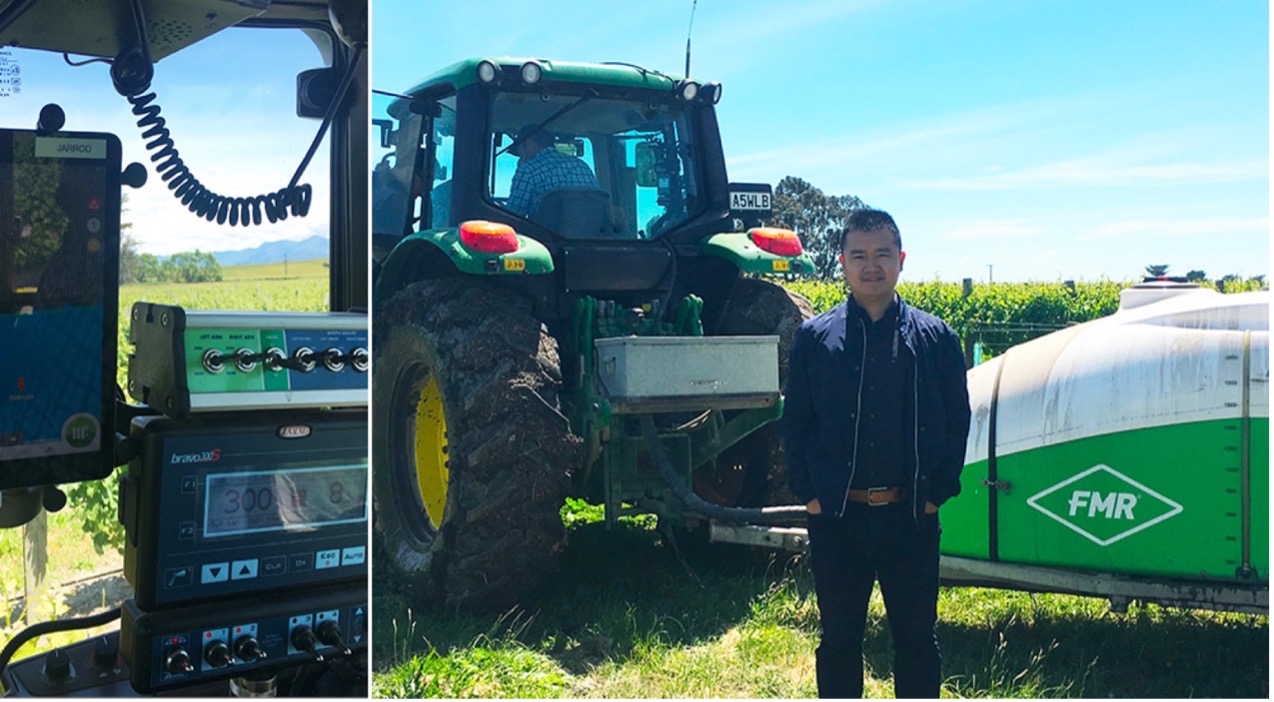
That was the moment I understood. Farms don't need a beautiful interface. They need software that works through dust, noise, and unreliable signal.
We rebuilt. Larger buttons, higher contrast, full offline tolerance so that data kept flowing when the cellular signal did not. In 2016 Lance expanded into New Zealand, and we went out there too, walking the same operational review on farms the other side of the Tasman.
Scaling the model
As NuPoint grew from Australia into New Zealand and then into North America, the commercial model had to change with it. Fixed-price contracts could not absorb the intensity of harvest season, when every idle hour of a GPS unit costs real money. We moved to a dedicated-team arrangement: headcount flexes up to twenty people in peak season and back down to five or six in quieter months. "Without that flexibility," Lance has said, "I could not have controlled the cost in the early years."
The architecture evolved with the business. The early monolithic server could not carry thousands of GPS-enabled machines streaming data at harvest. The platform migrated to a cloud-native AWS stack with DevOps automation. Storage went from 200 GB to 4–5 TB. Almost 2,000 machines are now connected, and the system holds up without anyone watching it overnight.
At harvest we used to stay up watching the servers. Now the system scales itself. We can finally sleep.
Outcome
From a single contact-form message, NuPoint has become a cross-continental agritech platform operating in Australia, New Zealand, and North America. Lance's public endorsement says it plainly: "Leon and his team are talented, efficient, dedicated and extremely resourceful. They have developed a system which is adaptable to any industry."
For the engineers, the story is simpler than that. A farmer in New Zealand once invited our team to a family dinner, and baked a birthday cake for one of them. Somewhere between the tractor cab in 2015 and that dinner table, the relationship had stopped being a vendor arrangement.
Founders do not need a contractor. They need a technical partner who will fly to their farm, sit in the cab, and treat the product's success as their own. The flexible team size — one to twenty and back — is what makes a ten-year partnership economically possible for both sides.